AI news in November 2026 is shaping up as the month the industry’s money story went fully public. Anthropic’s amended IPO filing put a near-17-billion-dollar quarter and hundreds of billions in compute commitments on the record, Google shipped a new frontier model just two weeks after its previous one, and OpenAI moved to merge ChatGPT and Codex into a single token allowance. Around the same time, four of the largest AI companies agreed to honor one shared opt-out signal for AI training.
This roundup continues our AI news October 2026 coverage. We look at what has actually changed since October 28, what stayed the same, and what each development means for developers, publishers and businesses that are building with AI rather than just reading about it.
News snapshot: November 3, 2026. Company announcements are identified as such; reported plans, estimates and claims are not guarantees of future performance.
What has changed since our October 2026 coverage
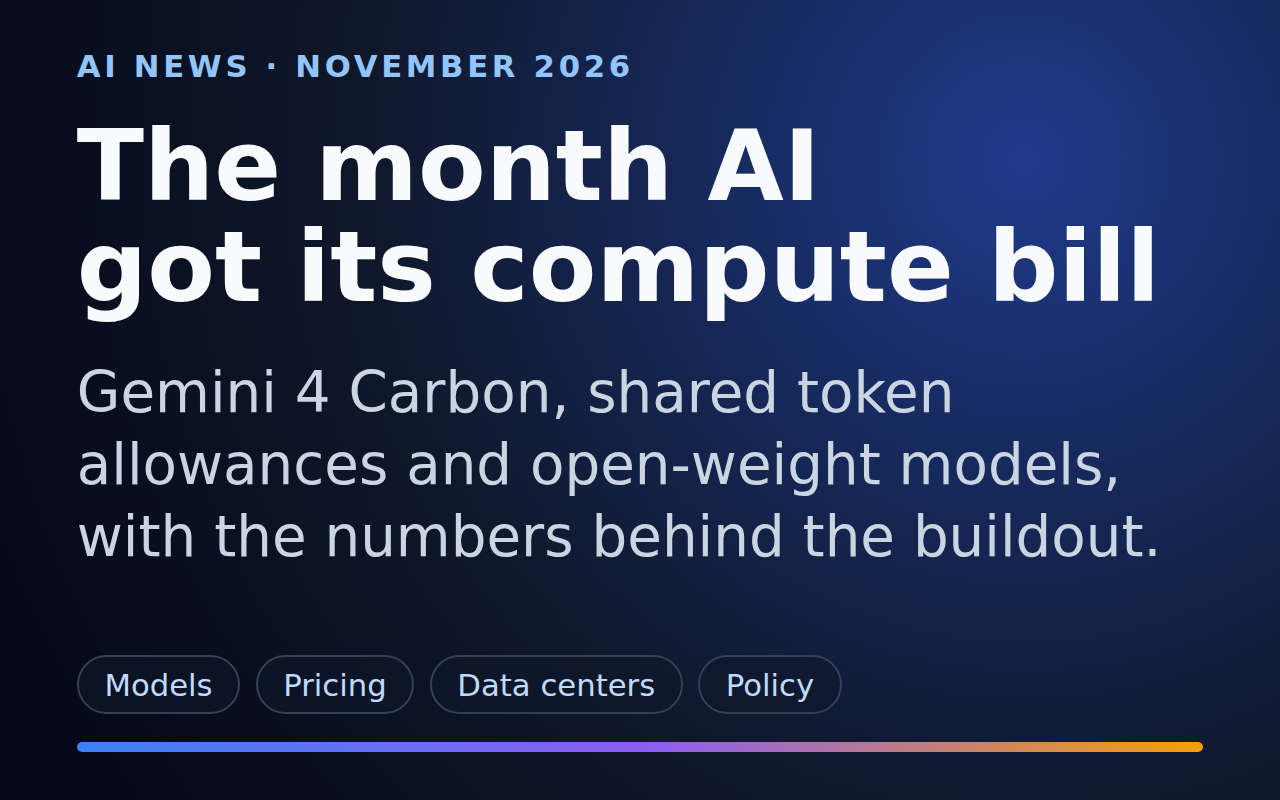
Our October roundup led with Anthropic’s initial S-1 filing, OpenAI’s GPT-6.1 Terra listing, Google’s Gemini 4 Argon, Elon Musk’s reported 40-billion-dollar GPU financing and a voluntary White House accord on AI safety. Those stories did not disappear in November; they developed.
- Anthropic’s filing grew teeth: an amended S-1 reportedly discloses quarterly revenue close to 17 billion dollars and roughly 895 billion dollars in compute commitments.
- Google replaced its flagship again: Gemini 4 Carbon arrived on October 28, two weeks after Argon, and took the top spot on a widely watched benchmark index.
- Consumer usage is being re-metered: from December, ChatGPT and Codex will draw from one shared token allowance on paid plans.
- Publishers got one lever instead of many: Google, Microsoft, OpenAI and Anthropic said they plan to honor a single robots.txt signal for AI-training preferences.
- Open weights moved upmarket: Mistral released the weights of its trillion-parameter Large 4 model for self-hosting.
The pattern across this month’s AI news is consolidation of power (money, chips, benchmarks) alongside an unusual amount of cooperation on standards. Both trends affect how you should plan AI projects for 2027.
Anthropic’s road to the public market: an amended S-1 with hard numbers
Anthropic filed its registration statement on Form S-1 with the U.S. Securities and Exchange Commission on October 26, as the company announced. The Claude maker intends to list its Class A shares on the Nasdaq Global Select Market under the symbol “ANT”. The filing did not yet set the number of shares or the price range, so any valuation figure you see quoted remains provisional.
What changed in November is the level of detail. According to CNBC’s continuing coverage of the S-1, an amended filing disclosed revenue for the most recent quarter near 17 billion dollars together with roughly 895.4 billion dollars in compute commitments. Treat those figures as disclosed obligations and reported revenue rather than as a verdict on profitability; compute commitments span years and depend on terms that are not fully public.
What the filing says about infrastructure
Reporting on the filing also highlighted a structural shift: instead of only renting capacity from Amazon and Google, Anthropic now leases data centers and the chips inside them and runs them to its own specification, Yahoo Finance summarized. One commentator described it as “reduplicating AWS”. The strategic point is control: owning the runtime reduces exposure to a single cloud vendor’s pricing and capacity decisions, at the cost of enormous capital commitments.
Separately, Anthropic announced on October 18 that a portion of its shares will go to a new Anthropic Public Benefit Fund, according to its newsroom, a structure intended to increase its stake as the company grows. Governance arrangements like this matter as much as revenue for public-market investors, because they determine who actually controls the company after listing.
OpenAI’s reported answer: a bigger raise at a bigger valuation
The IPO calendar is not the only money story. Reuters reported, as summarized by Analytics India Magazine, that OpenAI is accelerating a roughly 30-billion-dollar funding round at a potential valuation above 1.4 trillion dollars, ahead of Anthropic’s expected mid-November debut. Industry newsletters tracking the round put the amount secured so far near 11 billion dollars, which illustrates how long large raises can take even for the best-known names.
There is also fresh infrastructure news on Anthropic’s side of the ledger: Bloomberg reported that Anthropic and the infrastructure company Nscale are preparing a second compute agreement of about 45 billion dollars. That is a reported plan, not a signed and announced contract, so it should be treated as context rather than fact until the companies confirm it.
Claude Opus 5.5 is still the coding benchmark to beat
For developers, the most relevant Anthropic fact of the season is not the IPO but the model lineup. Claude Opus 5.5, announced in September, leads in agentic coding and knowledge work while costing about 40 percent less to run than Opus 5 on typical workloads, according to the company. Independent evaluations referenced later in this article still place it ahead of the newest Google flagship on coding-agent tasks.
Google’s Gemini 4 Carbon takes the benchmark crown two weeks after Argon
Google debuted Gemini 4 Carbon on October 28, as SiliconANGLE reported, only two weeks after introducing Gemini 4 Argon. Carbon is positioned as the company’s strongest model to date, with particular emphasis on cybersecurity and long-horizon work, meaning tasks that unfold over many steps or even days.
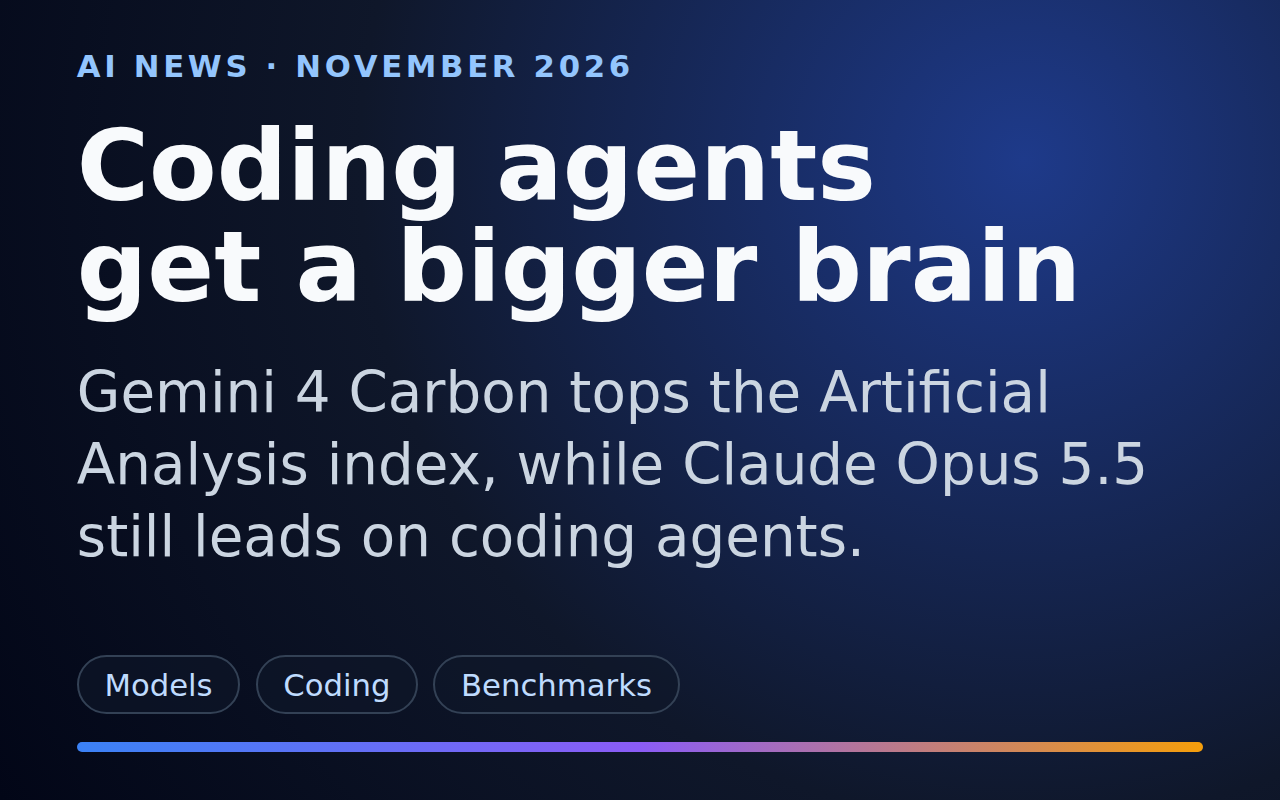
The headline result is a number-one score of 59 on version 5.0 of the Artificial Analysis Intelligence Index, up from Argon’s 50 on the previous version, 9to5Google reported. That index combines several popular model evaluations, so a five-point-plus jump in two weeks is notable even allowing for benchmark churn. On the same evaluator’s coding-agent index, Carbon scores 59 against Claude Opus 5.5’s 62, The Decoder noted, so the race at the top remains genuinely open.
Cybersecurity is the headline capability
Carbon’s most distinctive claims are defensive-security benchmarks. Google cites a firm lead in SEC-bench Pro at 88.2 percent for finding vulnerabilities, CWE-bench at 71.0 percent for patching them, and ExploitGym at 54.8 percent for exploitation tasks, according to 9to5Google’s summary of the announcement. Google also says internal tests show the model is more than twice as good at generating secure code; that is a vendor claim and should be validated on your own codebase before you rely on it.
Because of those cyber capabilities, access is starting narrow. Google is first making Carbon available to a subset of trusted cyber defenders in its Fairwind program and says it will expand access as soon as possible, The Verge reported. If you are evaluating models for production work, check current availability and regional restrictions directly rather than assuming a rollout has already reached your account.
ChatGPT and Codex will share one token allowance from December
One of the most practical items in this month’s AI news barely got a press release. OpenAI’s help center, in an article updated on October 31, explains the coming change: starting in December, Plus, Pro and Business plans will draw from a single usage allowance that covers both ChatGPT and Codex, measured in tokens. Instant chat will not draw from the allowance, and how much you use depends on the model you choose and the task you ask.
This is a quiet but significant shift in how consumer AI is billed. Until now, chatting and coding agents were effectively separate products with separate limits. Merging them into one token pool turns agent usage into the metered unit on consumer plans, which mirrors how developers already think about API costs. It also means a heavy afternoon of agent-driven coding can consume the same allowance you would otherwise spend on everyday conversations.
What builders should do before December
- Baseline your usage now. Check Settings and note your current ChatGPT and Codex consumption separately, so you can tell in December which activity is draining the shared pool.
- Move routine steps to cheaper paths. Instant chat stays outside the meter, and smaller models consume less of the allowance on simple tasks.
- Re-think your budget monthly, not yearly. Token-metered agent usage is lumpy; a single large refactor can dominate a week’s spend.
The same logic applies to any team running its own agents, which is why we track these mechanics in our guide to AI cost transparency and budget limits. If you compare coding assistants by cost, our comparison of AI coding tools uses task-level rather than headline pricing.
Four AI giants back one shared AI-training opt-out signal
Publishers have long complained that opting out of AI training means writing rules for every crawler: one line for GPTBot, another for ClaudeBot, another for Google-Extended. On October 30 and 31, that started to change. Google, Microsoft, OpenAI and Anthropic announced plans to honor a single robots.txt signal that states one training preference for all participating providers, as Search Engine Journal reported.
The mechanism comes from an Internet-Draft titled “Machine-Readable Training Preference Signal”, published on October 30 and authored by Kevin Kelley, a standards technical lead at Anthropic, within the IETF’s AI Preferences working group. A site operator writes one ordinary robots.txt group addressed to the token, and participating providers are expected to read that group as the site’s training preference, as one technical explainer details.
Why one token matters for publishers
The practical value is simplicity. A small publisher can state “do not train on my content” once, in a file it already maintains, instead of tracking every new crawler name. That lowers the cost of expressing a preference to near zero, which is exactly what a widely honored standard should do.
Keep the caveats in view, though. The draft is an individual submission, not an approved standard, and honoring a robots.txt preference remains voluntary, as Coywolf’s analysis stresses. Rules that already exist in robots.txt files are separate from the new token, and one participating company’s announcement may replace some controls sites currently use, so publishers with existing rules should review them. Legal routes to protect content, such as licensing and copyright enforcement, are unaffected.
Mistral Large 4 goes open weight with a trillion parameters
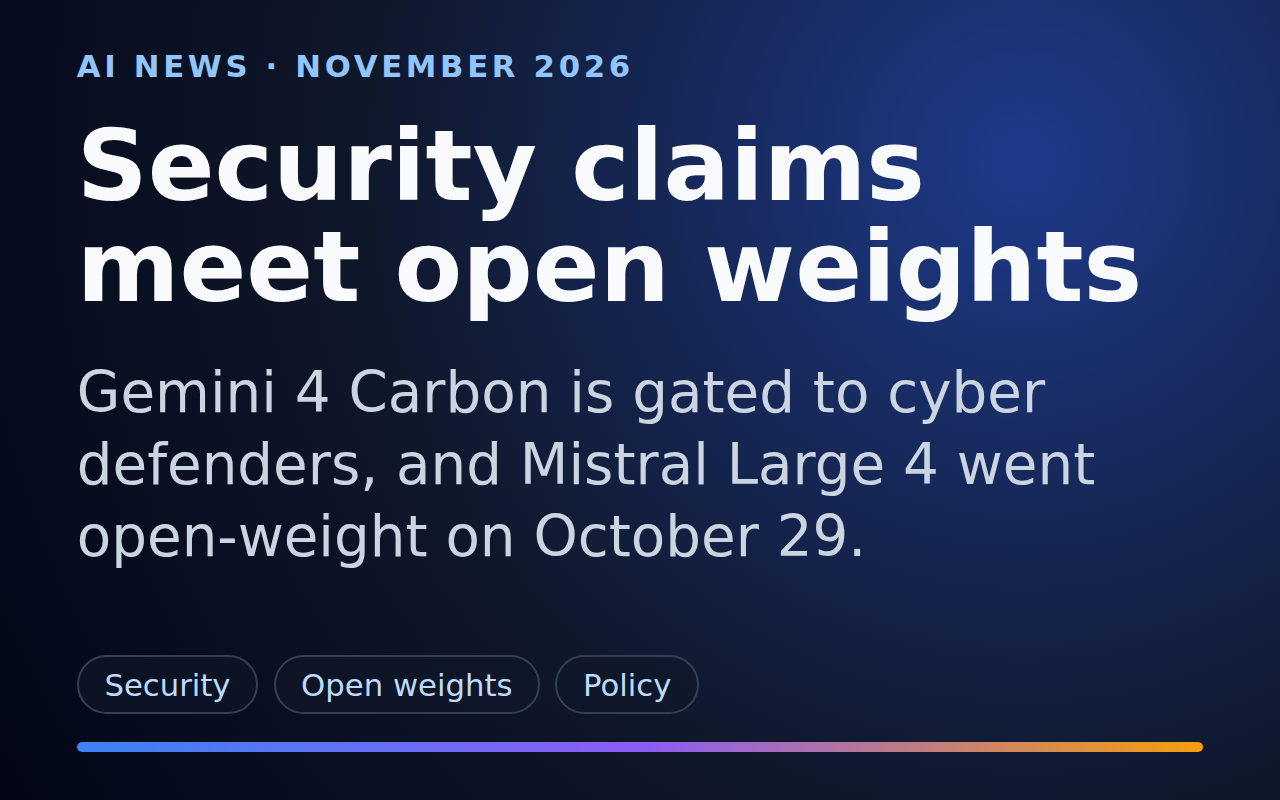
Mistral released the weights of Mistral Large 4, nicknamed “Le Chonk”, on October 29, as the company announced. The model has about 1.05 trillion total parameters with 52 billion active in its mixture-of-experts architecture, natively multimodal, a one-million-token context window, and a custom open-weight license that allows self-hosting under stated conditions.
Independent evaluation suggests the three extra weeks between the October 6 preview and the weight release went mostly into efficiency. Artificial Analysis scored ML4 at 26 on its Intelligence Index v5 at the high reasoning setting, up from 25 for the preview, as VentureBeat reported, alongside gains in cost per task and fewer fabricated answers. VentureBeat’s headline calls it the top open model outside China with a claimed 63 percent lower cost per task; those are third-party and vendor-adjacent figures, so treat them as signals rather than guarantees.
Why open weights matter again
Two forces make this release more consequential than a routine checkpoint. First, sovereignty: businesses and governments that cannot or will not send data to a foreign API now have a near-frontier option they can run themselves, as TechCrunch put it. Second, price pressure: an open model at a fraction of the token cost disciplines the pricing of closed providers, which benefits everyone building on AI.
The catch is operations. Self-hosting a trillion-parameter model means arranging GPUs, power, expertise and updates yourself. For most small teams, hosted access remains the pragmatic choice; for those with data-residency constraints, the calculus has clearly shifted.
AI for science: Rosalind expands and Claude enters the lab
Specialized models for scientific work took a step forward this month. OpenAI’s GPT-6 Rosalind, its life-sciences model, began rolling out to approved research organizations from October 30, according to third-party model trackers. It uses the same underlying weights as GPT-6 Astra but applies a looser dual-use boundary for biology, which is exactly why access stays gated behind a review process rather than a credit card.
Reported benchmark movements are large: life-sciences research success rose from 44.0 to 61.3 percent on a gold-standard set compared with the previous Rosalind 5.5, genomics agent success from 16.7 to 37.7 percent, and medicinal chemistry from 28.9 to 49.6 percent, as aggregated by independent trackers. These are reported results from a gated program, not an open challenge; independent replication will take time.
Anthropic, meanwhile, reported early results from using Claude to accelerate drug discovery with six partner companies, including antibody design and regulatory documentation work, according to a summary of the company’s October 27 announcement. The interesting engineering lesson is the same for both labs: domain models succeed when they are wired into real workflows with human experts reviewing outputs, not when they are queried cold.
OpenAI raises bug bounty payouts and launches a grid-relief program
OpenAI used the start of November to harden its own perimeter. The company announced that it is more than quadrupling rewards in its Security Bug Bounty program for critical findings and adding bonuses for report quality, researcher loyalty and priority campaigns; exceptional findings may qualify for up to about 172,000 dollars including bonuses, per OpenAI’s news feed. It is also preparing an internal security sprint with the firm Cathedral Systems, whose researchers will use OpenAI’s models alongside its teams to probe its defenses.
Money like that reflects where the frontier is moving. As models get better at finding vulnerabilities — Google’s Carbon benchmarks make the same point from the other side — the market for the humans and tools that find them first is expanding. Defensive AI is becoming a product category, not a feature.
The Grid Protectors Program
The second announcement is about electricity. OpenAI’s new Grid Protectors Program, launched November 2, will work with utilities so that future compute campuses can reduce demand during grid strain, with a pilot at a Georgia data-center campus that can free up to roughly 1,000 megawatts. Whether you read it as public relations or genuine grid stewardship, it acknowledges a physical fact: AI growth is now constrained as much by power as by chips.
Infrastructure and policy to watch this month
Two weeks ago we wrote that chips and data centers dominate the spending race. November added deal-making and politics to that story.
Marvell’s 115-billion-dollar bet on optical
CNBC reported on November 2 that Marvell agreed to acquire Lumentum in an all-stock deal of about 115 billion dollars, which trackers describe as the largest public-technology acquisition on record. The logic is bandwidth: AI clusters need optical interconnects at scales copper cannot reach. Consolidation at this level concentrates the supply chain that every AI builder depends on, which is worth watching even if you never touch hardware.
Data centers become an election issue
With U.S. governor races decided on November 3, The Information reported that candidates favoring pauses or restrictions on data-center construction could win as many as 15 of 36 contests. Local resistance to power, water and noise impacts is turning into electoral politics, which means the industry’s siting decisions are no longer made only in boardrooms.
xAI’s Memphis turbines face a lawsuit
A federal judge denied xAI’s motion to dismiss the NAACP’s Clean Air Act lawsuit over the gas turbines powering its Colossus data center outside Memphis, ruling that the turbines are not exempt mobile sources, as TechCrunch reported via industry newsletters. The case is early, but it tests whether data-center power choices can be litigated like any other industrial emissions question.
What the November 2026 AI news means for developers and businesses
Headlines move fast; habits are what compound. Here is how we would translate this month’s AI news into practice.
1. Watch usage meters, not just list prices
Between OpenAI’s shared ChatGPT-and-Codex allowance, Mistral’s cost-per-task gains and Anthropic’s disclosed compute commitments, the industry is converging on tokens as the unit that matters. Whatever you build, measure cost per completed task, including retries and human review, and set budgets before usage sets them for you. Our cost transparency guide shows the mechanics.
2. Treat open weights as a real option
Mistral Large 4’s release means data-residency and self-hosting requirements no longer force you to accept a large capability gap. If your constraints are regulatory rather than budgetary, benchmark the open option on your own tasks before assuming a closed model is the only fit.
3. Cybersecurity AI is becoming table stakes
Google’s Carbon and OpenAI’s bounty expansion are two ends of the same trend: models that find and fix vulnerabilities are arriving fast. Use them defensively first — scan your own projects, fix findings, log changes — and keep an agent harness with permission boundaries around anything autonomous, as described in our guide to AI agent control.
4. Plan for the opt-out era
If you publish content, add your AI-training preference in one place once the token is honored by your providers, and review existing crawler rules for conflicts. If you build AI products that consume web content, assume that more of the web will express preferences and design your data practices to respect them.
Outlook: consolidation, containment and compute
Three threads run through AI news in November 2026. Consolidation: Anthropic heads toward a landmark IPO while chip and optics deals concentrate the supply chain. Containment: frontier cyber capabilities ship behind trusted-access gates, and a shared opt-out token tries to contain data disputes. Compute: the binding constraint of the year now shows up in S-1 footnotes, utility programs and election campaigns alike.
None of this changes the fundamentals we highlighted in October. The teams that win with AI are not the ones that switch models most often; they are the ones with repeatable evaluation, explicit budgets and clear boundaries on what their agents may do. The next milestone to watch is Anthropic’s listing itself, and, on the model side, whether Carbon’s broad access arrives as promised.
AI news November 2026: frequently asked questions
What is the biggest AI story in November 2026?
Anthropic’s amended S-1 filing, which reportedly discloses quarterly revenue near 17 billion dollars and about 895 billion dollars in compute commitments ahead of its planned Nasdaq listing under the symbol “ANT”. Valuation and share count remain unset, so quoted figures are provisional.
What is Gemini 4 Carbon and who can use it?
Gemini 4 Carbon is Google’s newest frontier model, released October 28, two weeks after Gemini 4 Argon. It tops the Artificial Analysis Intelligence Index v5 at 59 and leads several cybersecurity benchmarks. Initial access is limited to trusted cyber defenders in Google’s Fairwind program, with broader access promised.
How does the shared ChatGPT and Codex allowance work?
From December, ChatGPT Plus, Pro and Business plans use one token-based allowance covering both ChatGPT and Codex. Instant chat does not draw from it, and usage depends on the model chosen and the task. OpenAI advises checking your usage patterns ahead of the change.
Can I stop AI companies from training on my website?
You can now state a preference with a single robots.txt token that Google, Microsoft, OpenAI and Anthropic have said they plan to honor. It is a voluntary signal from an IETF draft, not a law, so publishers who need stronger protection still rely on licensing and legal remedies.
What is the best open-weight AI model right now?
Mistral Large 4, whose weights were released October 29, is a leading candidate: about 1.05 trillion parameters, a one-million-token context window and strong coding results, with independent evaluations highlighting its efficiency. “Best” depends on your task, license needs and hardware; run your own tests.