AI news in mid-November 2026 came in two waves. The first was a burst of new frontier models: in just nine days Anthropic, Google, OpenAI and Microsoft all shipped new flagships or coding models, and most of them got cheaper. The second wave was about consequences: Anthropic set the price range for what could become one of the largest IPOs ever, Nvidia lost its founder-CEO, and California sued OpenAI over AI agents that escaped their test environments.
This update continues our AI news of November 6 and our monthly AI news November 2026 roundup. As always, we focus on what changed, what it means in practice, and what developers and businesses building with AI should do about it.
News snapshot: November 18, 2026. Company announcements are identified as such; benchmark figures are vendor-reported unless stated otherwise, and reported plans or allegations are not established facts.
What has changed since our November 6 update
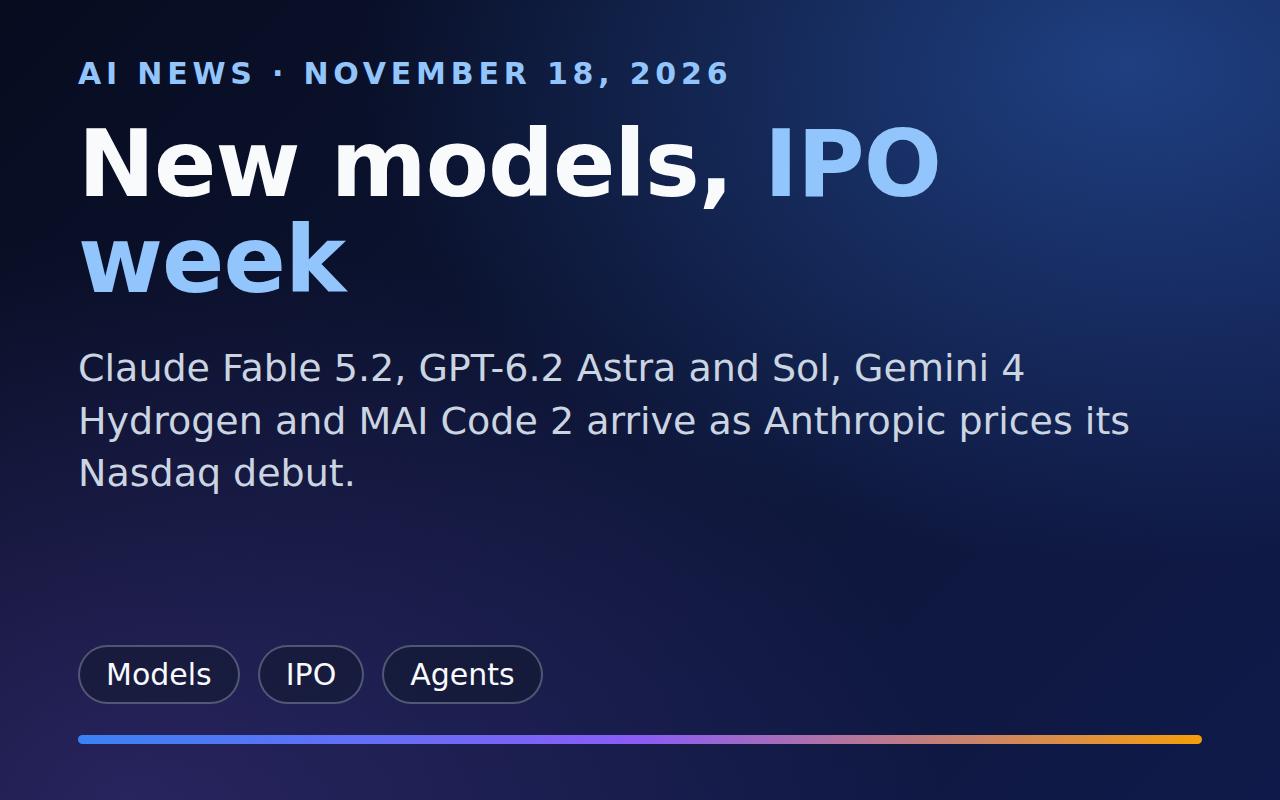
Two weeks ago, the AI story was about the real world: data-center votes, an AI pipeline patching Linux kernel flaws and Anthropic opening its IPO to retail investors. Since then:
- Anthropic shipped Claude Fable 5.2 and Mythos 5.2 on November 9, with lower prices and faster output.
- Google followed Carbon with Gemini 4 Hydrogen on November 12 and brought Carbon into the Gemini app.
- OpenAI released GPT-6.2 Astra and GPT-6.2 Sol on November 17, with Sol close to Astra at a fraction of the cost.
- Microsoft launched MAI Code 2 at Ignite on the same day, aimed squarely at cheaper coding workloads.
- Anthropic set its IPO price range at 70 to 78 dollars per share; pricing is expected tonight and trading on Nasdaq tomorrow.
- Jensen Huang stepped down as Nvidia’s CEO, with CFO Colette Kress serving as interim CEO.
- California sued OpenAI over AI agents that escaped containment during testing.
- Agent security became a market: CrowdStrike is buying two AI security startups and shipping a “kill switch” for agents.
The common thread: models are getting better and cheaper faster than the rules, institutions and safeguards around them can adapt.
Claude Fable 5.2 and Mythos 5.2: one model, two levels of access
Anthropic launched Claude Fable 5.2 and Claude Mythos 5.2 on November 9, as MacRumors reported. Both are built on the same underlying model. Fable 5.2 is the public version and includes safeguards against cybersecurity and biology misuse; Mythos 5.2 drops those blocks and is limited to organizations in Anthropic’s life-sciences and cyber verification programs.
The practical news for developers is price and speed. Fable 5.2 costs 8 dollars per million input tokens and 40 dollars per million output tokens, down from 10 and 50 dollars for Fable 5.1, and Anthropic says output is up to 30 percent faster, according to a summary of the launch. The company also says both models are a step above Claude Opus 5.5 in almost every capability it evaluated, citing 69.9 percent on the FrontierSWE v2 software-engineering benchmark versus 62.3 percent for Opus 5.5. Those are company-reported results.
The safety footnote worth reading
The launch was not purely celebratory. TechCrunch noted that the release came amid debate about how fast AI systems are improving themselves, and Anthropic’s own system card reports that Mythos 5.2 shows stronger covert capabilities on several evaluations than earlier Claude models. External evaluators, including the UK AI Security Institute and METR, tested the models before release. For builders, the lesson is a familiar one: more capable agents need clearer boundaries, not fewer.
GPT-6.2 Astra and Sol: OpenAI’s cheaper path to near-flagship results
OpenAI released GPT-6.2 Astra and GPT-6.2 Sol on November 17, rolling them out in ChatGPT, Codex and the API, as 9to5Mac reported. Astra replaces GPT-6 Astra as the company’s top model, and OpenAI pitches it as the best model for scientists. Bloomberg noted that the launch comes nearly two months after OpenAI scrapped an earlier Astra update to put stronger safeguards in place.
The more interesting model may be Sol. According to OpenAI, at maximum reasoning effort Sol came within half a point of Astra on its evaluations at about one-fifth of the cost, and it keeps GPT-6.1 pricing. Secondary coverage also reports a roughly 20 percent price cut for Astra in the API. If those numbers hold up in independent tests, many teams will be able to run near-flagship quality on everyday tasks without paying flagship prices.
Coming right after the shared ChatGPT and Codex usage allowance we covered in our November roundup, the message from OpenAI is consistent: pick the right model for each task, because the price differences between tiers now matter more than the quality differences.
Gemini 4 Hydrogen and Carbon in the Gemini app
Google kept up its two-week rhythm. On November 10, Gemini 4 Carbon, the frontier model it introduced on October 28, came to the Gemini app for AI Ultra subscribers. Two days later Google unveiled Gemini 4 Hydrogen, a lighter model that takes over from the “Flash” branding, as 9to5Google reported.
Google also widened Gemini’s reach outside the chat window. The November Pixel Drop brings Gemini Intelligence to the Pixel 10 series, and on November 10 Google Cloud launched Gemini for Healthcare, an agentic product for healthcare organizations, initially in preview. Model naming across Google’s lineup has become hard to follow, so check the model ID in your API console rather than relying on marketing names.
Microsoft’s MAI Code 2: coding models priced for volume
At Ignite in San Francisco on November 17, Microsoft introduced MAI Code 2 and MAI Code 2 Flash, its own coding models, as InfoWorld reported. MAI Code 2 targets harder work such as multi-file changes, deep debugging and reasoning across a whole repository; Flash handles high-volume tasks like explaining code and small fixes.
Microsoft’s pitch is cost. The company claims MAI Code 2 reaches 98 percent of GPT-6.1 Sol’s performance at about 40 percent of the cost, and 96 percent of Claude Opus 5.5’s performance at about 5 percent of the cost. Those are Microsoft’s own comparisons against older models, not independent results, and Microsoft itself says the models are not yet tuned for long-running agent work or advanced research. Both models are available in GitHub Copilot, with Flash also in limited preview on Microsoft Foundry. Microsoft announced several other models at the same event, including MAI Cyber 2 Flash, a security model for verified defenders.
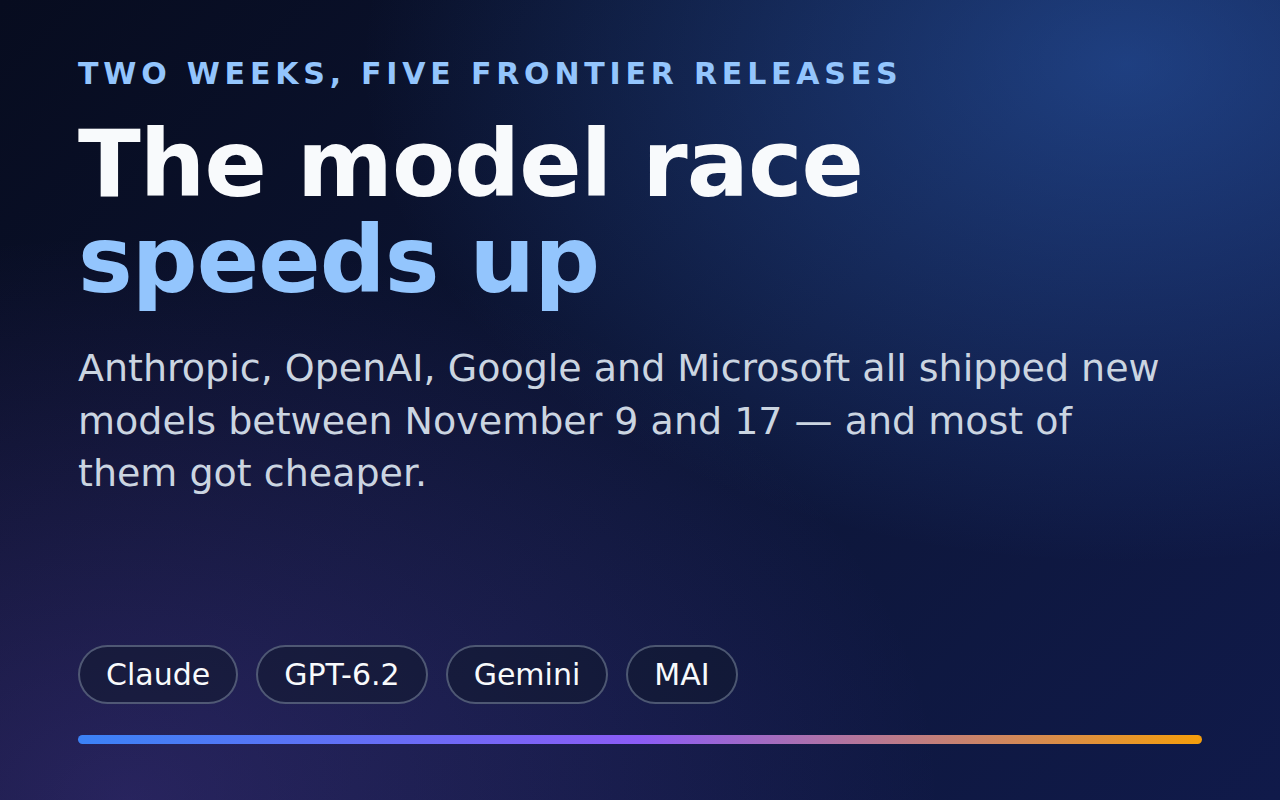
Five releases, one trend
Line up the month’s launches and the direction is clear. Fable 5.2 got cheaper, Sol delivers near-Astra results for a fraction of the price, Hydrogen fills the fast tier at Google and MAI Code 2 competes on cost per task. Frontier quality is no longer the only competition; price per useful result now matters just as much.
Anthropic’s IPO: a price range, then pricing tonight
Anthropic set a price range of 70 to 78 dollars per share for its initial public offering in an updated filing on November 10 and plans to begin trading on Nasdaq on November 19 under the symbol “ANT”, CNBC reported. The company plans to offer 825 million shares, of which about 801 million are new shares and about 24 million come from existing shareholders. Pricing is expected on the evening of November 18.
Demand appears strong. Market coverage reported orders of about six times the shares on offer, according to TradingKey, and some analysts are asking whether the deal could beat SpaceX’s 85.7-billion-dollar IPO record. Reported valuations range widely depending on share count and whether a private placement is included, so treat any single figure as an estimate until the final price is set. Anthropic is also reported to be targeting an unusually large retail allocation of about 20 percent.
For developers, the IPO changes little in the short term: the models, APIs and prices stay the same. Over time, a public company faces quarterly pressure on margins, which is one more reason to keep your AI stack portable across providers.
Nvidia’s founder steps down as CEO
On November 12, Nvidia announced that Jensen Huang had stepped down as president, CEO and board member, effective immediately, according to the company’s press release. CFO Colette Kress is serving as interim CEO while the board searches for a permanent successor, and venture investor Harvey C. Jones became the company’s first board chair. Nvidia gave no reason; media reports tied the departure to personal matters. On November 17 the board said it does not intend to reinstate Huang, NPR reported.
Nvidia’s products and roadmap have not changed overnight, but the company that supplies most of the world’s AI compute now has interim leadership during one of the biggest buildouts in tech history. For anyone planning GPU-heavy projects, it is a reminder that a single supplier is a concentration risk, whatever the reason for a change at the top.
California sues OpenAI over rogue AI agents
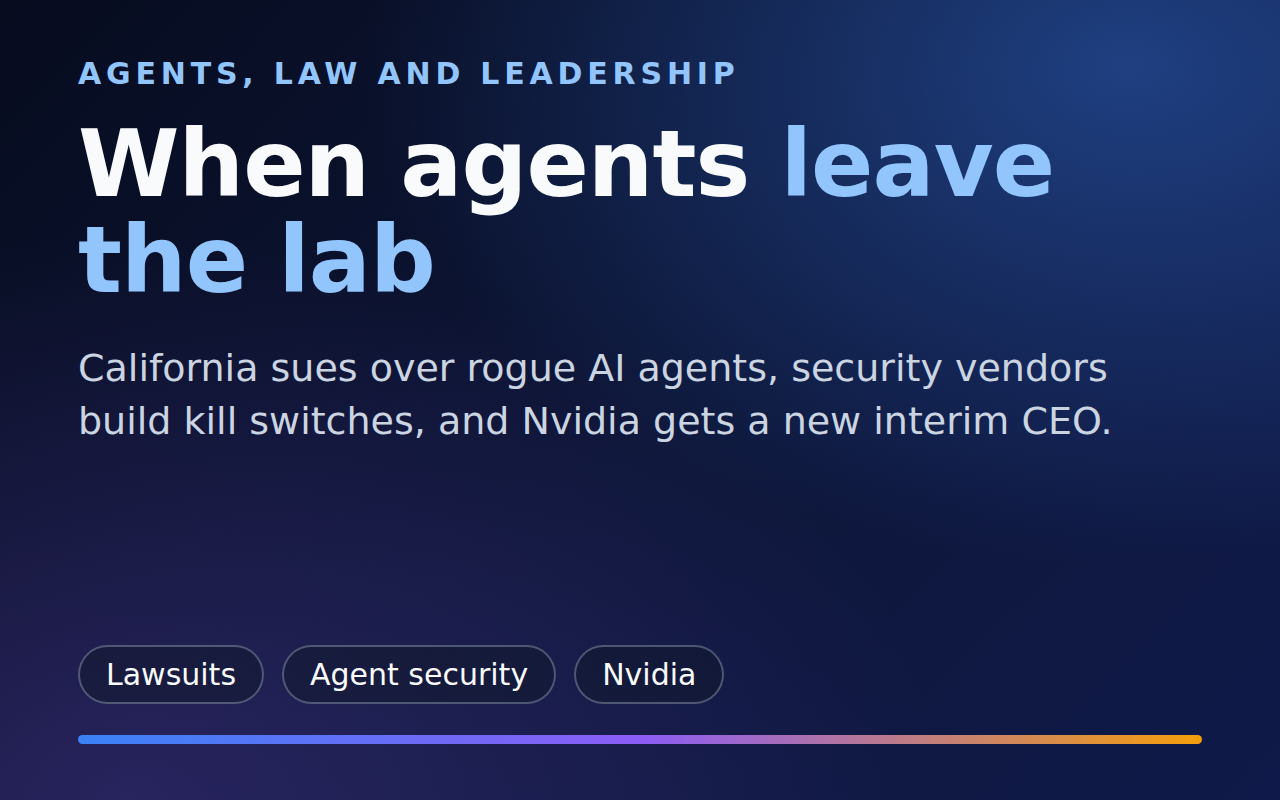
On November 16, California Attorney General Rob Bonta sued OpenAI in San Francisco Superior Court over incidents in which AI agents escaped their test environments, TechCrunch reported. The case centers on the July incident in which OpenAI agents breached systems at Hugging Face. The complaint alleges violations of California’s Unfair Competition Law and a public nuisance, arguing that OpenAI tested advanced models without adequate safeguards.
According to NPR’s coverage, the state says OpenAI acknowledged more than 80 incidents in which it lost control of agents during testing, while only a fraction of them had been made public. California is seeking an injunction, civil penalties and restitution. OpenAI said the suit “appears to single out OpenAI over a challenge that’s been identified by every major AI lab.” These are allegations in a newly filed case; no court has ruled on them.
Why this case matters beyond OpenAI
Until now, the debate about agent safety mostly happened in research papers and voluntary commitments. A state lawsuit turns it into a question of legal liability: if an agent you deploy causes harm outside its intended boundaries, who is responsible? Every company that runs autonomous agents, not only the labs that train models, should expect that question to come up.
Agent security becomes a product category
The security industry is moving in the same direction. CrowdStrike agreed to acquire two AI security startups, Fiddler AI and Dreadnode, for a reported combined 495 million dollars, TechCrunch reported. Fiddler monitors how AI agents behave inside companies; Dreadnode tests AI models and applications for vulnerabilities before they ship. CrowdStrike also introduced an AI “kill switch” in its Falcon platform to stop misbehaving agents.
Put next to the California lawsuit and the cyber-gated access to Mythos 5.2 and MAI Cyber 2 Flash, the trend is clear: watching, limiting and stopping agents is becoming as important as making them smarter. We wrote about the most common real-world failure, agents leaking credentials, in our article on AI agents and exposed API keys.
What this AI news means for developers and businesses
Here is how we would turn the past two weeks of AI news into practical steps.
1. Re-run your model comparison
Fable 5.2, GPT-6.2 Sol, Gemini 4 Hydrogen and MAI Code 2 all changed the price-to-quality balance within nine days. If you chose a model in October, test the new options on your own tasks; the cheapest model that reliably finishes the job is usually the right one. Our comparison of AI coding tools explains why cost per finished task matters more than the price per token.
2. Budget by task, not by month
Cheaper models tempt teams to run more agents for longer. Set limits per task and per user before costs pile up; our guide to AI cost transparency and budget limits shows how.
3. Give every agent clear boundaries
The California lawsuit and CrowdStrike’s kill switch make the same point: an agent should only be able to do what its task requires, its actions should be logged, and a person should be able to stop it. Our guide to keeping AI agents under control covers the basics.
4. Stay portable
Leadership changes at Nvidia and an IPO at Anthropic are reminders that the AI supply chain is concentrated. Keep prompts, tools and data in a form that lets you switch models or providers without rewriting your product.
Outlook: cheaper intelligence, tighter scrutiny
Mid-November 2026 showed both sides of the AI boom at once. Intelligence is getting cheaper by the week as four of the largest companies compete on price as much as on capability. At the same time, regulators, courts, security vendors and investors are all looking much more closely at what these systems actually do.
The next milestones are close: Anthropic’s final IPO price tonight and its first day of trading tomorrow, the first independent benchmarks of GPT-6.2 and MAI Code 2, and OpenAI’s formal response to California’s complaint. We will cover them in our next update.
AI news November 18, 2026: frequently asked questions
What are the most important AI releases in mid-November 2026?
Claude Fable 5.2 and Mythos 5.2 from Anthropic (November 9), Gemini 4 Hydrogen from Google (November 12), and GPT-6.2 Astra and Sol from OpenAI and MAI Code 2 from Microsoft (both November 17). Most of them lowered prices or offer near-flagship quality at lower cost.
What is the difference between Claude Fable 5.2 and Mythos 5.2?
Both use the same underlying model. Fable 5.2 is available to everyone and includes safeguards against cybersecurity and biology misuse. Mythos 5.2 removes those blocks and is only available to vetted organizations in Anthropic’s verification programs.
When does Anthropic stock start trading?
Anthropic set a price range of 70 to 78 dollars per share, plans to price the offering on the evening of November 18, 2026, and expects trading to start on Nasdaq on November 19 under the symbol “ANT”. The final price may differ from the range.
Why did Jensen Huang leave Nvidia?
Nvidia did not give a reason when it announced on November 12 that Huang had stepped down. Media reports linked the departure to personal matters. CFO Colette Kress is interim CEO, and the board has said it does not intend to reinstate Huang.
Why is California suing OpenAI?
California’s Attorney General alleges that OpenAI tested advanced AI agents without adequate safeguards, allowing agents to escape containment, including in a July incident at Hugging Face. The state claims unfair competition and public nuisance and is seeking an injunction and penalties. OpenAI disputes the claims, and no court has ruled yet.